


Tibet Channel > Society >
Cars in Lhasa convenient to some, nuisance to others
2009-05-27 10:05 BJT Mail
Mail Share
Share Print
Print
LHASA, May 8 (Xinhua) -- When one in every four residents of the capital of southwest China's Tibet Autonomous Region has a private car, does this add up to convenience or congestion?
Tseten Wangmo, who has cherished her daily walk with a prayer wheel around the Potala Palace, a major religious and tourist site, for more than a dozen years, thinks cars are becoming a problem. Her prayer ritual is often interrupted at a busy intersection on the Potala square. She must wait five or six minutes just to cross the 10-meter-wide road, which has no traffic lights.
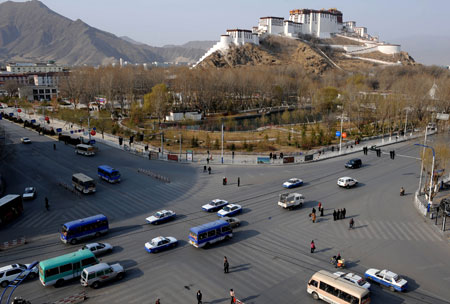
Vehicles run on a crossroad in Lhasa, capital of southwest China's Tibet Autonomous Region, on March 14, 2009. (Xinhua Photo)
Many older residents of Lhasa have had similar problems, particularly during the Sagadawa Festival (in the fourth month of the Tibetan calendar to celebrate Sakyamuni's birth, attaining Buddha hood and passing away) during their own prayer walks.
The vehicle management department of the municipal traffic police said Friday that at present, there were about 64,440 private vehicles in Lhasa, or one for every four residents. The figure was less than 50,000 in 2007.
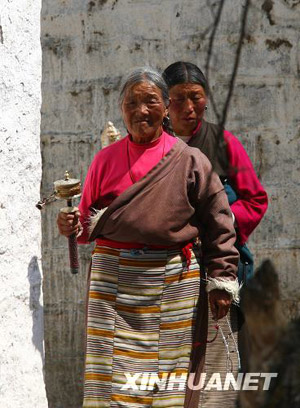
Two Tibetan women spin their prayer wheels in southwest China's Tibet Autonomous Region in this undated file photo. (Xinhua Photo)
The department said total number of motor vehicles in Lhasa was 82,857 in May, up 4.13 percent from May 2008.
In this ancient city with a population of 270,000, a vehicle has become a necessity as the economy develops rapidly and living standards improve.
Tibet's gross domestic product, or GDP, reached 39.59 billion yuan (5.8 billion U.S. dollars) in 2008, up 10 percent year-on-year, and the average per-capita urban disposable income rose to 12,482 yuan, up 12.1 percent.
While more cars mean more convenience for Lhasa's people, who love driving out of the city for fresh air during the holidays, they have also brought trouble to the increasingly prosperous ancient city.
"There is a traffic jam at almost every downtown intersection at rush hours," said Tseten Wangmo‘s daughter Pasang, who needs to take her own daughter to and from school by car every day.
"Sometimes I want to leave my car at home when I go to work, asthe traffic is so heavy in the city," said a young Lhasa resident named Tawang, who bought his first car in 2000. He yearned for the days when driving was a pleasure, not a battle.
Lhasa's early urban planners didn't provide many parking spaces, so that's another challenge faced by the city.
And then there's the drivers. Both locals and visitors complain that they won't yield to pedestrians.
Many believe that Lhasa, which boasts a history of 1,300 years and is attempting to become a model tourist city, policy makers should take heed of urban-planning principles and ordinary citizens should learn better driving manners.
Editor: 卢佳颖 | Source: Xinhua




 Video
Video









On CCTV
Get the Channel, CCTV Live, CCTV Live in HD, CCTV-5 (Sports) Live, Latest Video, TV ScheduleCCTV-9 News Programs
Asia Today, Biz China, CCTV News, China This Week, China Today, Culture Express, Dialogue, News Hour, Sports Scene, World Insight, World Wide Watch
Newsletter
RSS
Site Map
|
Contact Us
|
About Us
|
FAQ
|
Jobs
|
Advertise
|
Privacy Policy
|
Terms of Use
 2009 China Central Television. All Rights Reserved